Analysis · TEMPO House

TEMPO House: the analysis.

This is the strategic record behind TEMPO House: our marketing strategy, the SWOT, and what was actually built and delivered. The build story, milestones and results are on the case study.

Our Marketing Strategy

The strategy we set, and the thinking behind it.

  1. 01

    A venue that contradicts itself cannot be recommended

    Search engines and assistants both synthesise an answer from whatever a venue publishes about itself, and they treat a self-contradicting source as low confidence. TEMPO House was publishing five different capacities for the same rooms, so the most basic qualifying question a planner asks had no reliable answer anywhere. Reconciling the facts was not housekeeping ahead of the marketing: it was the prerequisite, because every citation earned afterwards would have pointed at a source that argued with itself.

  2. 02

    The platform is the marketing

    A booking flow that works in Vietnamese, a confirmation that arrives when it should, a floor plan a client can actually read before they sign: each of those does more for a venue's reputation than a campaign does, and each is a brand surface whether or not anyone treats it as one. Building the platform and the identity in the same engagement is what keeps them from drifting, and it is why the brand system documents motion and forms alongside colour and type.

  3. 03

    The uncontested category is café plus gallery, and Saigon has no claimant

    Hanoi has one venue holding the café-and-gallery position with real multi-source presence. Ho Chi Minh City has none, and the category is durable to whoever claims it first. The nearest competitor on Pasteur Street runs marketing exhibitions rather than a curated programme, and the counter is specificity: TEMPO programmes its gallery, names its curator and publishes its exhibitions as events with dates. That is a stronger claim than any adjective, and it is machine-readable.

Our Assessment

The assessment.

The venue was never the problem. TEMPO House had a better structured-data footprint than every competitor checked and a room nobody else in the city has, and it was invisible in the searches that matter because nothing outside its own website said it existed. Fixing that starts with making the site's own facts agree, then earning the third-party citations answer engines actually synthesise from.

Marketing Execution

What was built. What was delivered.

Brand

Identity & System

  • Brand foundation and positioning
  • Colour, typography and logo system
  • Layout, components, forms and motion standards
  • Photography art direction and shoot brief
  • Rendered brand specimen and asset library
Digital

Guest-Facing Platform

  • Bilingual marketing website, English and Vietnamese
  • Table reservation flow and waitlist
  • Automated reminders, feedback and no-show handling
  • Event programme CMS and artwork ingest
  • Structured data and answer-engine retrievability
Operations

Staff & Revenue Tools

  • Event floor-plan designer at surveyed scale
  • EventPlanner CRM and guest records
  • Point-of-sale integration and revenue reporting
  • Payment gateway and multi-payer ticketing
  • Single source of truth for every venue fact

SWOT Analysis

Strengths, weaknesses, opportunities, threats.

Strengths

Integration & Infrastructure

  • Three complementary revenue modes in one building: café, bar, gallery and events
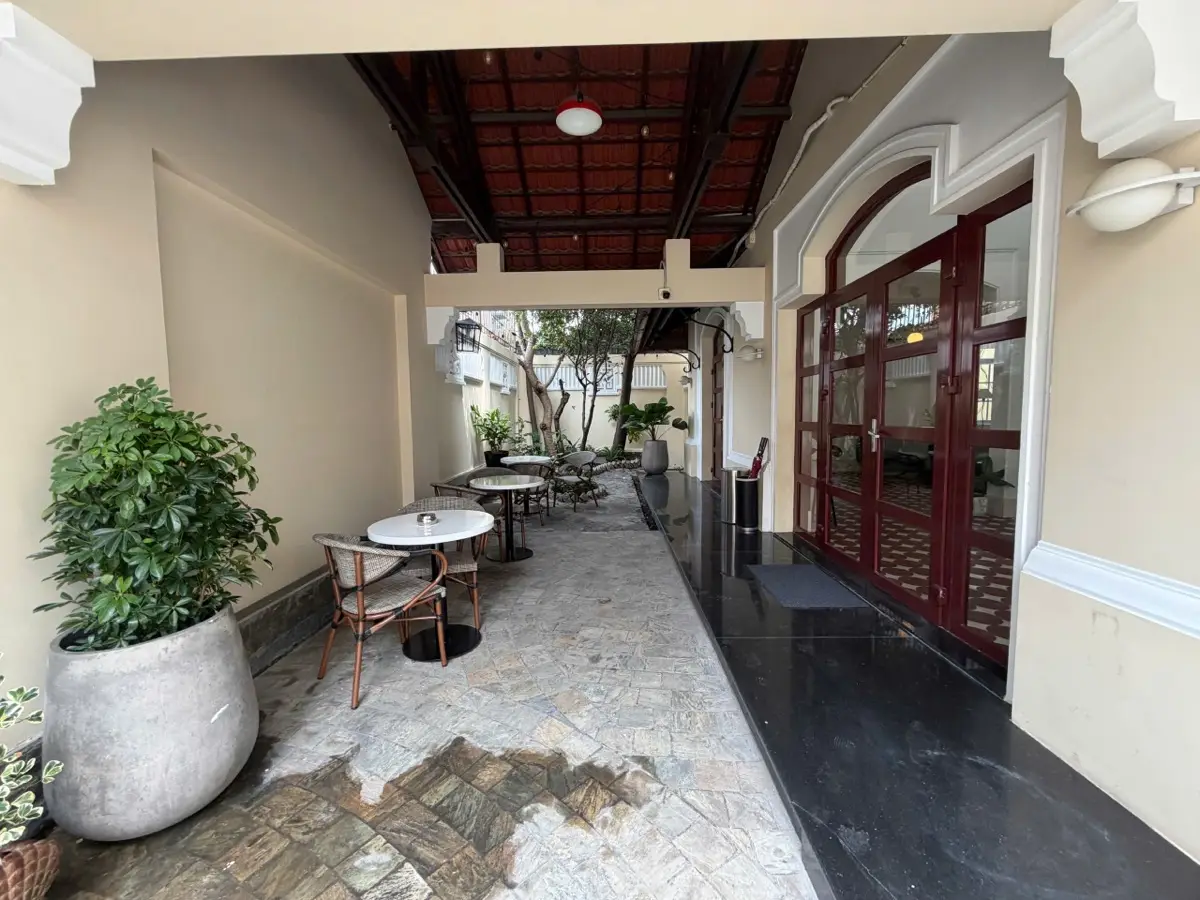
  • A 1930s villa in District 3, a location and a room no competitor can replicate
  • Purpose-built operating platform rather than four disconnected tools
  • Sustained 4.8 star Google rating
  • Genuinely bilingual across every guest surface
Weaknesses

Complexity & Footprint

  • Three modes demand three operating disciplines from one team
  • ÊM Gallery sits on Level 1 with no lift, which limits part of the events offer
  • Small floor areas cap the largest functions against hotel ballrooms
  • Professional photography commissioned but not yet delivered

Opportunities

An Uncontested Category

  • Café plus gallery has no established claimant in Ho Chi Minh City
  • Corporate and brand activation demand for non-hotel venues
  • Gallery programme as a recurring reason to return, and as content
  • Third-party editorial and platform listings, currently near zero

Threats

Density & Discovery

  • One of the most competitive food and beverage markets in Southeast Asia
  • A neighbouring brand centre already outranking TEMPO in Vietnamese results
  • Anti-trend positioning makes discovery slower by design
  • Event bookings carry a long lead time and uneven cash flow

The build

How TEMPO House was made.

Ready to start?

Let's build something worth talking about.